I. Comparison of Visibility Sensor Types and Measurement Principles
1. Transmissometer Visibility Sensor
Measurement Principle: Adopts the baseline measurement method. A light transmitter (transmitting end) and a light receiver (receiving end) are installed at both ends of a known distance (usually 10–75 meters). The transmitter emits light of fixed intensity, and the receiver measures the attenuation of light. According to the Beer-Lambert Law, the atmospheric extinction coefficient is directly calculated by measuring the transmittance of light in the atmosphere, thereby deriving the Meteorological Optical Range (MOR).
Advantages:
Highest accuracy, recognized as the reference method by the World Meteorological Organization (WMO).
Directly measures the extinction coefficient, which is theoretically closest to the definition of visibility.
Good adaptability to different weather conditions such as fog, rain, and snow, with stable measurement results.
Disadvantages:
Requires a long baseline (usually tens of meters), high site requirements, and complex infrastructure.
Complex installation and commissioning; the transmitter and receiver must be precisely aligned.
Window contamination (e.g., dust, raindrops) has a significant impact on measurements, requiring frequent cleaning or automatic cleaning devices.
Generally higher cost.
2. Forward Scatter Visibility Sensor
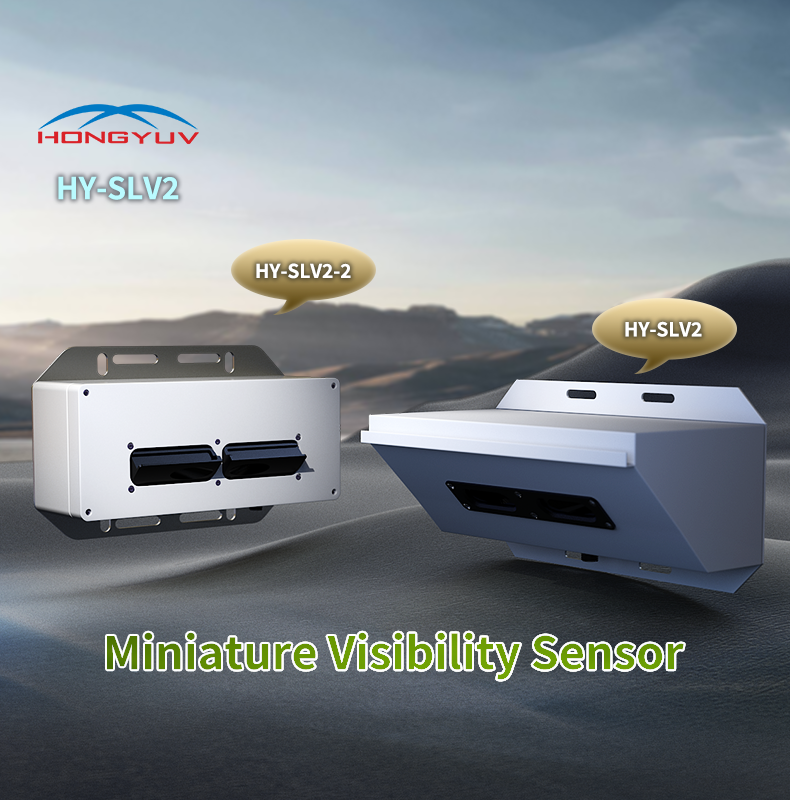
Measurement Principle: The most mainstream visibility sensor currently. The transmitter emits infrared light at a specific angle (usually 30°–45°) and measures the forward-scattered light intensity (close to the original beam direction) of aerosol particles in a volume of air in front of it. The scattered light intensity is inversely related to visibility; through calibration and algorithmic models, the extinction coefficient and visibility value are inverted.
Advantages:
Compact structure, small size, easy installation, no long baseline required.
Less sensitive to window contamination than transmissometers.
Mature technology, high cost performance, and relatively simple maintenance.
Fast response speed.
Disadvantages:
Indirect measurement; calibration relies on transmissometers or theoretical models, making it a "secondary measurement" in principle.
Measurement results are affected by particle size distribution, shape, and composition, with potential errors under different types of fog (radiation fog, advection fog) or precipitation conditions.
May have limitations in measuring uneven fog very close to the ground.
3. Backscatter Visibility Sensor
Measurement Principle: The transmitter emits a light beam and measures the backscattered light signal that returns almost along the original path (usually at a small angle or coaxial with the emitted beam). Visibility is estimated based on the empirical relationship between backscattered intensity and total extinction coefficient.
Advantages:
The most compact structure, usually a single-ended design with all optical components integrated into one probe, making installation extremely convenient.
Particularly suitable for installation on mobile platforms (e.g., vehicles, ships) or space-constrained locations.
Disadvantages:
The most empirical measurement principle, with generally lower accuracy than forward scatter sensors, especially at very high or very low visibility.
Stronger dependence on aerosol properties; calibration and stability are challenging.
4. LiDAR Visibility Sensor (Fog LiDAR)
Measurement Principle: An active remote sensing device. It emits laser pulses into the atmosphere and receives signals scattered by aerosols and molecules in the atmosphere (including Mie scattering and Raman scattering). By analyzing the attenuation of the echo signal with distance, the spatial vertical or horizontal distribution of the extinction coefficient is inverted, obtaining slant visibility or profile information.
Advantages:
Provides spatial distribution information, not just single-point data. For airports, it can detect fog layer height and evolution trends.
Long detection range (several kilometers to over ten kilometers).
Disadvantages:
Extremely expensive equipment with complex operation and maintenance.
Complex data processing algorithms.
Mainly used for high-end, scientific research, and specific early warning scenarios (e.g., large airports, meteorological research).
5. Video Visibility Sensor (Digital Imaging Method)
Measurement Principle: A high-definition camera captures fixed targets at known distances, sizes, and brightness in the distance (e.g., black targets, mountains, buildings). Using image processing technology, the contrast attenuation between the target and the background sky is analyzed, and visibility is calculated according to the Koschmieder Law.
Advantages:
Intuitive, with a measurement principle closest to human eye observation.
Can reuse existing surveillance camera networks, potentially reducing hardware costs.
Can simultaneously obtain large-scale real-time weather images.
Disadvantages:
Accuracy is greatly affected by lighting conditions (day/night, backlight), target characteristics, and image quality; auxiliary light sources are required for night measurements.
Complex algorithms; stability is greatly affected by weather and environment.
Currently mostly used as auxiliary or qualitative observation methods, difficult to serve as standard instruments for high-precision quantitative measurements.
II. Differences in Application Environments and Selection Recommendations
| Instrument Type | Typical Application Scenarios | Selection Reasons and Notes |
| Transmissometer | 1. Meteorological reference stations 2. Large hub airports (as calibration references) 3. Scientific research and calibration laboratories | Fixed sites requiring the highest measurement accuracy and authoritative data; acceptable for high installation and maintenance costs. |
| Forward Scatter | 1. Civil airports (runway meteorological observation) 2. Expressways (visibility monitoring and early warning) 3. Ports and waterways 4. Conventional meteorological observatories 5. Wind power and grid safety monitoring | The most widely used; achieves the best balance between accuracy, stability, installation convenience, and cost, suitable for most scenarios requiring continuous automatic visibility monitoring. |
| Backscatter | 1. Mobile platforms (trains, ships, scientific research vehicles) 2. Space-constrained sites (e.g., lighthouses, offshore platforms) 3. Early warning systems with slightly lower accuracy requirements | Primary need for simple installation and compact structure; mostly for mobile or narrow spaces; need to understand accuracy limitations. |
| LiDAR | 1. Large international aviation hubs (monitoring fog layers, clear air turbulence) 2. Meteorological research and early warning (research on haze spatial structure) 3. Major event support | Requires 3D spatial structure information of visibility, not just single-point data; sufficient budget and professional maintenance capabilities. |
| Video | 1. Expressway monitoring systems (as auxiliary verification) 2. Urban visibility grid monitoring 3. Tourist attractions and public meteorological services (providing real-time images) | Mainly used for visual auxiliary monitoring, public services, and qualitative early warning; often used with other visibility sensors to provide "image evidence". |
III. Comprehensive Comparison
| Characteristic Dimension | Transmissometer | Forward Scatter | Backscatter | LiDAR | Video |
| Measurement Principle | Direct (transmission attenuation) | Indirect (forward scattering) | Indirect (backscattering) | Remote sensing (spatial scattering) | Indirect (image comparison) |
| Accuracy Grade | Highest (reference) | High (operational mainstream) | Medium | High (spatial distribution) | Low/highly condition-dependent |
| Installation Complexity | High (requires long baseline) | Low | Very Low | Very High | Low (relies on existing camera points) |
| Maintenance Requirements | High (requires alignment, cleaning) | Medium | Medium | Very High | Medium (lens cleaning, algorithm maintenance) |
| Spatial Information | Single-point | Single-point | Single-point | 3D profile/horizontal distribution | 2D image area |
| Cost | High | Medium | Medium-Low | Extremely High | Low-Medium (relies on existing hardware) |
| Core Application Scenarios | Reference calibration, high-precision requirements | Operational automatic monitoring | Mobile platforms, compact installation | Scientific research, aviation high-end early warning | Auxiliary monitoring, public services |
Conclusions and Selection Recommendations
- For most operational and automatic monitoring needs (e.g., airports, expressways, meteorological stations), forward scatter visibility sensors are the preferred and most common solution due to their comprehensive advantages in accuracy, reliability, installation and maintenance convenience, and cost.
- Transmissometers can be selected when the highest legal or scientific accuracy of data is required.
- Backscatter sensors can be considered for mobile or extremely space-constrained installation scenarios.
- LiDAR and video sensors serve specific high-end remote sensing or visual auxiliary needs.
Selection should comprehensively consider measurement requirements, environmental conditions, budget, and maintenance capabilities.